Binding managers calculate costs by the book, but they tend to think about trimming in terms of machine speed. Those two views rarely meet in the same meeting. The truth is that trimmer speed drives unit cost through several channels at once—labor per book, fixed cost per book, energy per book, and knife wear per book. Understanding how those channels work turns a "how fast is it?" question into a proper cost decision.
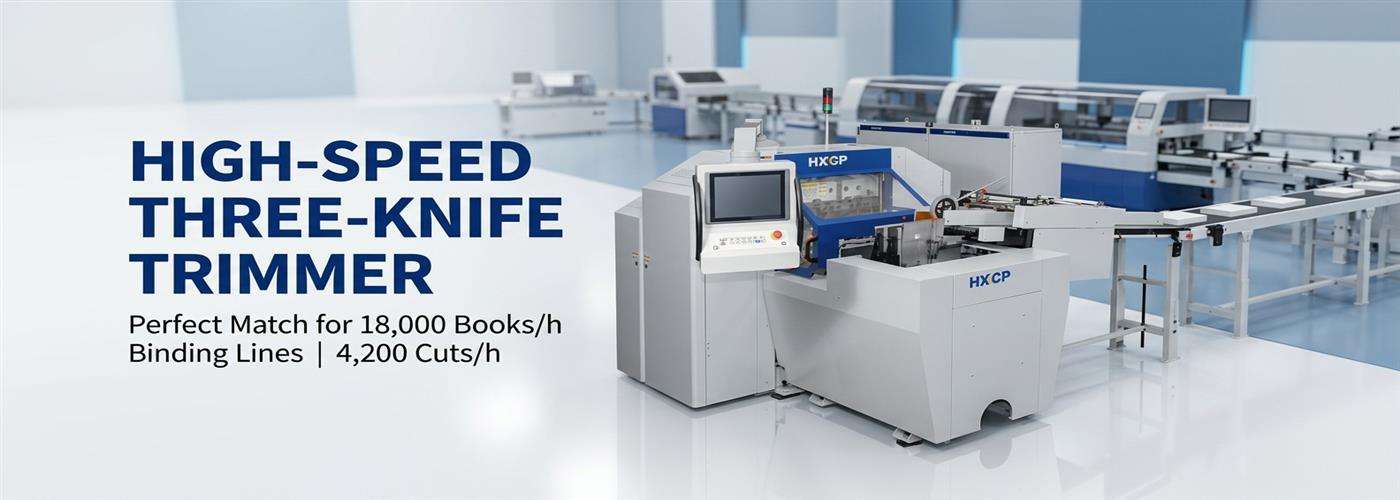
The Two Speed Numbers That Drive Every Trimming Cost CalculationA three-knife trimmer has two speed specifications that matter independently. The first is cutting speed—how many cutting cycles per hour the knife mechanism can complete. The second is feeding speed—how many books per hour the machine can deliver into the cutting station. On a machine like the HX150DH, cutting speed runs 300 to 4,200 cuts per hour and feeding speed runs 300 to 15,000 books per hour. The relationship between them is the stacking multiplier: each cutting cycle processes a stack of multiple books, so books per hour equals cuts per hour times books per stack.
Both numbers matter for cost. Feeding speed caps the line's output. Cutting speed, combined with stack depth, determines whether the trimmer can keep pace. A mismatch in either direction creates cost: an underfed trimmer wastes the binder's capacity, and an overfed one creates buffers that hold work-in-progress capital. Why Stacking Depth Is the Lever That Multiplies ThroughputStacking depth—2 to 80mm on the HX150DH—is the single most powerful lever in trimming economics. Consider a run of thin 4mm journals. An 80mm stack holds 20 books per cycle. At 4,200 cycles per hour, that is 84,000 books per hour of theoretical throughput—far beyond any binder, meaning the trimmer is never the constraint and the line runs at full capacity.
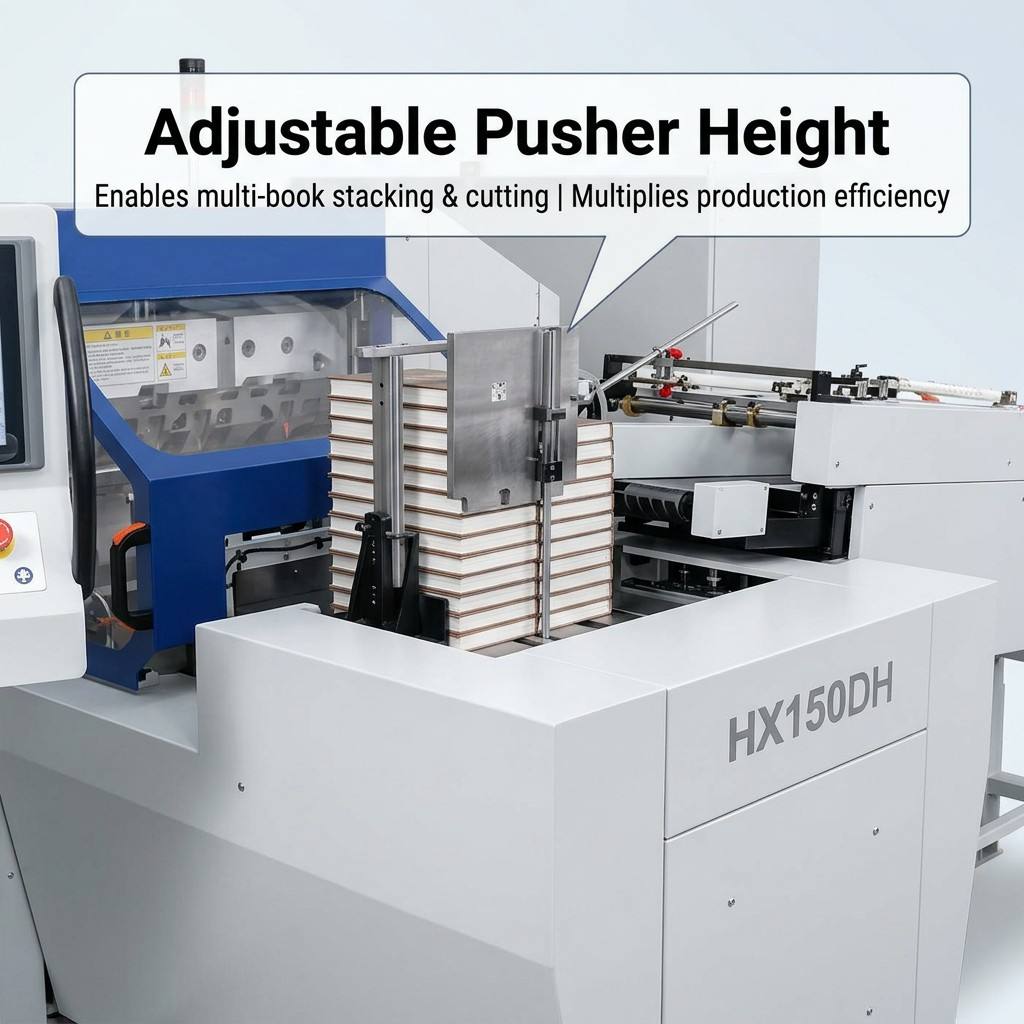
Now consider the same machine on 40mm textbooks. The stack holds two books, and 4,200 cycles per hour yields 8,400 books per hour. On this product, the trimmer becomes the constraint unless the binder runs below that level. The lesson: product mix determines whether a given trimmer spec is adequate. Facilities running mostly thin products can accept a lower cycle rate; facilities running thick products need every cycle per hour they can get. Fixed Cost per Book: The Case for Running Fast on Long RunsThe trimmer's purchase price and installation cost are fixed regardless of output. Amortized over its service life, fixed cost per book falls as throughput rises. A machine producing 6,000 books per hour carries twice the fixed cost per book as one producing 12,000, on identical capital expense. This is why speed matters most on long, repetitive runs. A textbook publisher running 500,000 copies of one title benefits enormously from a trimmer that cuts the finishing time in half. The fixed cost per book drops, the line turns around faster, and the facility can take on more work with the same floor space. On short, varied runs, the fixed cost advantage shrinks because total volume is lower and changeover time becomes proportionally more significant. Labor per Book at Different Speeds and Stacking DepthsOperator labor is the most visible cost in trimming, and it scales inversely with throughput. A trimmer that processes 4,000 books per hour with one operator carries one quarter of the labor cost per book of a trimmer processing 1,000 with the same operator. The HX150DH's automation—stream feeding, automatic stacking, pusher adjustment—reduces the operator role to monitoring and job setup, which is why one operator can manage the machine at high output.
The stacking multiplier extends this advantage. Deep stacking of thin products means fewer cycles, fewer load/unload events, and less operator attention per book. On a 20-book stack, the operator's per-cycle actions are spread across 20 books instead of one. Over a shift, the difference in operator time per book is substantial. Energy and Compressed Air Costs Per BookEnergy cost per book is small in absolute terms but worth understanding. The HX150DH draws 14kW on three-phase 380V, and its energy consumption is roughly proportional to operating time at a given output level. Doubling throughput halves energy per book. The same logic applies to the compressed air requirement of at least 6 Pa—air is consumed per cycle, so more books per cycle means less air per book. These costs are not the reason to choose one trimmer over another, but they do matter when comparing a fast machine against a slow one over years of operation. On a line running 6,000 hours per year, the energy and air savings from higher throughput accumulate into a four-figure annual difference. A Worked Example: Thin Books on a High Speed TrimmerTo see how these channels combine, run a realistic example. A facility produces 4mm journals on a binding line rated at 12,000 books per hour, paired with the HX150DH running 4,200 cuts per hour with 20-book stacks. The trimmer's theoretical output is 84,000 books per hour—far beyond the binder—so the trimmer is never the constraint and the line runs at 12,000 books per hour. Trimming labor: one operator, 8 hours, 96,000 books trimmed per shift. Labor per book is negligible. Fixed cost: at 96,000 books per shift across 300 shifts per year, the machine processes 28.8 million books annually, spreading the capital cost extremely thin. Knife wear: 20-book stacks mean 80mm cuts, so knives are changed more often, but the cost per book remains modest. The result is a trimmer cost per book measured in fractions of a cent.
A Second Worked Example: Thick Textbooks on the Same MachineNow run the same machine on 40mm textbooks at 8,400 books per hour effective throughput. The line must run at or below this speed, so if the binder is rated at 12,000 books per hour, 30 percent of its capacity is wasted unless the facility adds a second trimming path or accepts the constraint. Labor per book doubles relative to the thin-book example, fixed cost per book rises by 43 percent, and the capital investment's return stretches longer. This is the calculation that should precede the purchase. The trimmer's cost per book is not a fixed number—it depends on your product mix. A machine that is excellent for a thin-product facility may be marginal for a thick-product facility at the same price. When Higher Trimmer Speed Does Not PaySpeed is not always the answer. If demand is the constraint—the facility cannot sell more than it produces—a faster trimmer simply sits idle part of the time, and the fixed cost advantage vanishes. If the product mix is dominated by thick books with heavy changeover frequency, the cycle speed advantage erodes because the machine spends a larger share of its time changing over rather than cutting. The right-sizing rule is to match the trimmer's effective throughput to the binder's sustained output for the actual product mix, with margin. The HX150DH's 15,000 books per hour feeding speed suits lines whose binders deliver at that level. Buying more speed than the binder can feed wastes capital. Buying less speed than the binder delivers wastes the binder's capacity. The correct purchase sits at the intersection of the two. Building the Per Book Cost Model Before You NegotiateBring the cost model to the negotiation table. For your product mix, calculate books per hour at the proposed trimmer's cycle speed and your stack depths, then derive labor per book, fixed cost per book, energy per book, and knife cost per book. Ask the supplier for knife life data and maintenance cost estimates to complete the model. The supplier's quoted machine price is a single number. The per-book cost over five years of operation is the number that should drive the decision. A machine that costs 10 percent more but delivers 30 percent higher effective throughput on your product mix is the cheaper machine in every meaningful sense. Speed is not a marketing attribute—it is a line item in your unit economics. |
| Tag:three knife trimmer,three knives trimmer,book block,perfect binding,book trimming machine |
Please Leave Your Messenger Here!
We will do our best to make your business prosperous!





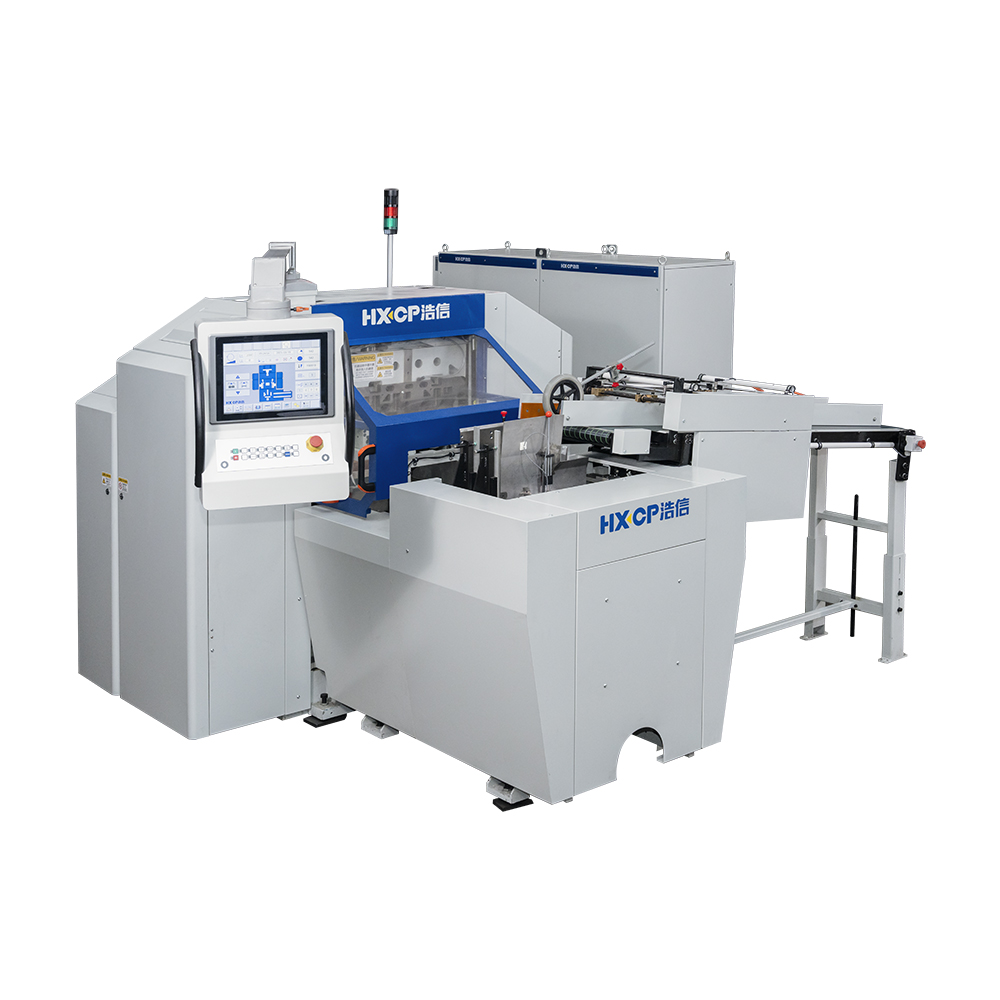 HX150DH High Speed Three Knife Trimmer