A three-knife trimmer is one of the largest single investments in a post-press department, and the wrong choice can cap your binding line's output for a decade. The right choice, though, transforms the line: finished books flow out at the binder's full rated speed, edges are square, and the trimmer never becomes the topic of a production meeting.
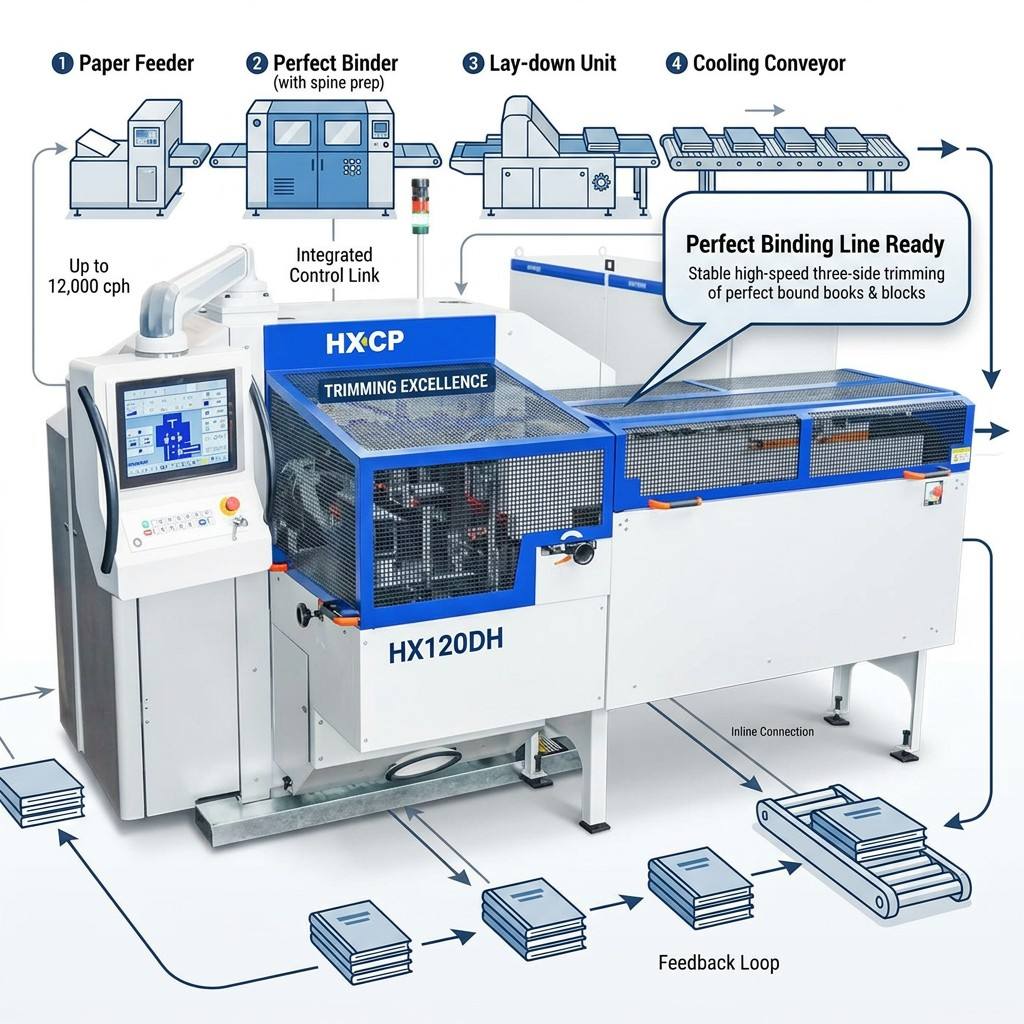
Step One Decide Whether You Need a Standalone or Inline TrimmerThe first decision is architectural. Will the trimmer operate as a standalone unit serving multiple lines, or will it be connected inline with a high-speed perfect binding line? The answer determines the speed, buffering, and control requirements you should specify.
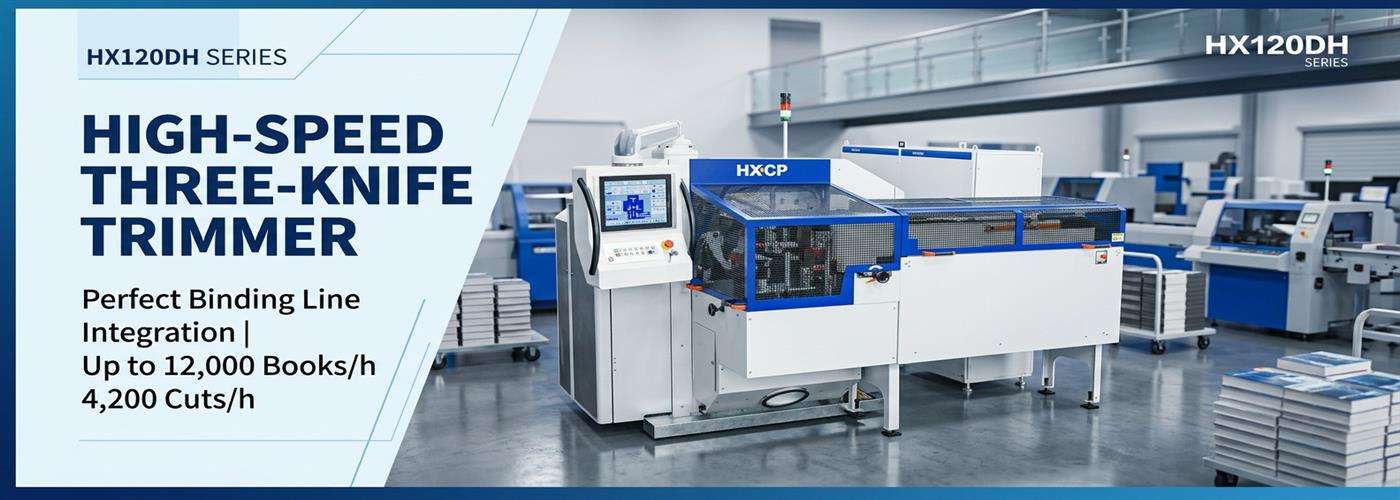
A standalone trimmer processes books that arrive in batches from one or more binding lines. It needs good stacking depth to process batches efficiently, but its speed can be more moderate because it absorbs work over time rather than in real time. An inline trimmer faces a harder requirement: it must keep pace with the binder's continuous output or the entire line slows to its speed. The HX120DH is designed to serve both configurations—it operates standalone, and its 300 to 12,000 books per hour feeding range lets it match inline high-speed lines up to 12,000 books per hour. Step Two Match Trimmer Throughput to Your Binder's Real SpeedBinder speed ratings are optimistic. The real speed depends on paper weight, book thickness, glue type, and cover stock. Before specifying a trimmer, measure your binder's actual sustained output over a full shift—not the rated figure on the spec sheet. The trimmer's effective throughput must exceed that real number with margin. Effective trimmer throughput equals cycles per hour multiplied by books per cycle. A trimmer rated at 4,200 cuts per hour cutting stacks of ten books processes 42,000 books per hour—far beyond any binder. Cutting stacks of two books, it processes 8,400 books per hour, which still exceeds most binders. The stacking depth range, 2 to 80mm on the HX120DH, determines how many books fit in a stack for any given book thickness. Thinner books mean deeper stacks, higher throughput, and more headroom.
Step Three Understand How Stacking Design Affects ReliabilityThe mechanism that builds stacks is the part of a trimmer that fails most often. Books must be separated from the incoming stream, aligned precisely, and stacked to a uniform depth before clamping. A belt conveyor separates books reliably at high speed, and a dual pre-stacking station design doubles the effective buffering by building one stack while trimming the other. When evaluating stackers, ask about the separation mechanism at high feed rates. Book-to-book friction, cover tack from hot-melt adhesive, and static cling can all cause mis-feeds. A robust separation system handles these conditions without jamming, because a jam at the stacker stops the entire line. The HX120DH's belt conveyor separation and dual pre-stacking stations are designed specifically to sustain the 300 to 12,000 books per hour range without frequent operator intervention.
Step Four Verify the Book Size Range Covers Your Entire Product MixNothing is more frustrating than a trimmer that cannot process the product a customer just ordered. Verify that the trimmer's size range covers your full portfolio—today's and tomorrow's. The HX120DH trims books up to 305 by 420mm after cutting and as small as 70 by 100mm, spanning pocket journals to full-size textbooks. Pay attention to the "before trim" versus "after trim" dimensions. Books must be slightly larger before trimming to provide material for the knives to remove. The HX120DH accepts books up to 310 by 430mm before trimming, giving a comfortable margin for cover overhang and tolerances. If your binder produces blocks at the very top of the trimmer's range, verify that the margin is adequate for your cover design. Step Five Check Trim Thickness Range Against Your Stacking StrategyThe trim thickness range—2 to 80mm on the HX120DH—defines both the thinnest booklet the trimmer can process and the deepest stack it can cut in one cycle. Both ends matter. The minimum thickness matters for small booklets and thin journals. If your product line includes 2 to 5mm booklets, a trimmer whose minimum is 10mm simply cannot process them, forcing you to a separate finishing route. The maximum thickness matters for throughput. A deep 80mm stack cut in one cycle multiplies the effective books per hour several times over. The stacking strategy should deliberately use deep stacks for thin products, balancing cycle time against knife load. Step Six Evaluate Precision Features That Protect Edge QualityA trimmer that cuts fast but imprecisely is a liability disguised as an asset. Precision in a three-knife trimmer comes from three systems: the clamping system that holds the stack rigidly during cutting, the knife guidance that keeps blades perpendicular to the table, and the knife quality and sharpening schedule that maintain clean edges.
When you evaluate a trimmer, ask for the edge tolerance specification and for sample cuts on your own product. Compare the squareness of trimmed corners and the consistency across the full stack depth. A well-built machine holds tolerance across the entire 80mm stack; a marginal machine drifts as stack depth increases. The machine's 6,000kg frame weight is not incidental—the mass provides the rigidity that keeps the knife guides stable under cutting load. Step Seven Confirm the Infrastructure Before You CommitInstallation surprises are expensive and entirely preventable. The HX120DH requires a level industrial floor rated for its 6,000kg weight, plus separate space for the 500kg electrical box. Power is 13kW on three-phase 380V, and compressed air must be available at a minimum of 6 Pa. Confirm these requirements against your facility's infrastructure before signing anything, not after delivery. For inline installation, verify the control interface compatibility between the trimmer and your binder. The trimmer's feeding speed range of 300 to 12,000 books per hour must synchronize with the binder's output, and the physical interface—conveyor heights, transfer points—must align. A reputable supplier should provide installation drawings and interface specifications during the quotation phase. Step Eight Ask the Questions That Reveal Long Term Support QualityThe machine is half the purchase; the supplier is the other half. Ask about knife sourcing and cost—trimmer knives are consumables, and their price and availability affect your operating cost permanently. Ask about the PLC platform and whether local technicians can service it. Ask about the preventive maintenance schedule and what it costs per year. Ask for references from facilities running the same model at comparable speeds, and ask those references specifically about reliability issues they have encountered.
A supplier who answers these questions with specific, documented information is treating you as a long-term partner. A supplier who deflects or promises without detail is selling you a machine and hoping the relationship ends at delivery. Step Nine Plan the Installation Timeline and Operator TrainingA trimmer purchase involves more than the machine itself. For the HX120DH, installation includes floor preparation for the 6,000kg machine and the separate 500kg electrical box, a 13kW/380V three-phase power connection, and a compressed air supply at a minimum of 6 Pa. Most installations complete within one to two weeks, with the line offline only during final connection and testing. Operator training covers the control interface, stack depth programming, and the preventive maintenance schedule. Because the trimmer automates the stacking and cutting sequence, experienced operators typically reach full proficiency within a few shifts. Plan this time into your production schedule, and the transition will be smooth rather than disruptive. The Bottom Line on Trimmer SelectionThe right three-knife trimmer is the difference between a binding line that runs at its rated speed and one that quietly underperforms. Match the trimmer's effective throughput to your binder's real output, verify the size and thickness ranges cover your full product mix, confirm the precision systems hold quality at speed, and choose a supplier with the support infrastructure to keep the machine running. Get those four decisions right, and the trimmer stops being a topic of discussion and becomes the reliable finishing station your line was designed to have. |
| Tag:three knives trimmer,three knife trimmer,book block,perfect binding,book trimmer |
Please Leave Your Messenger Here!
We will do our best to make your business prosperous!





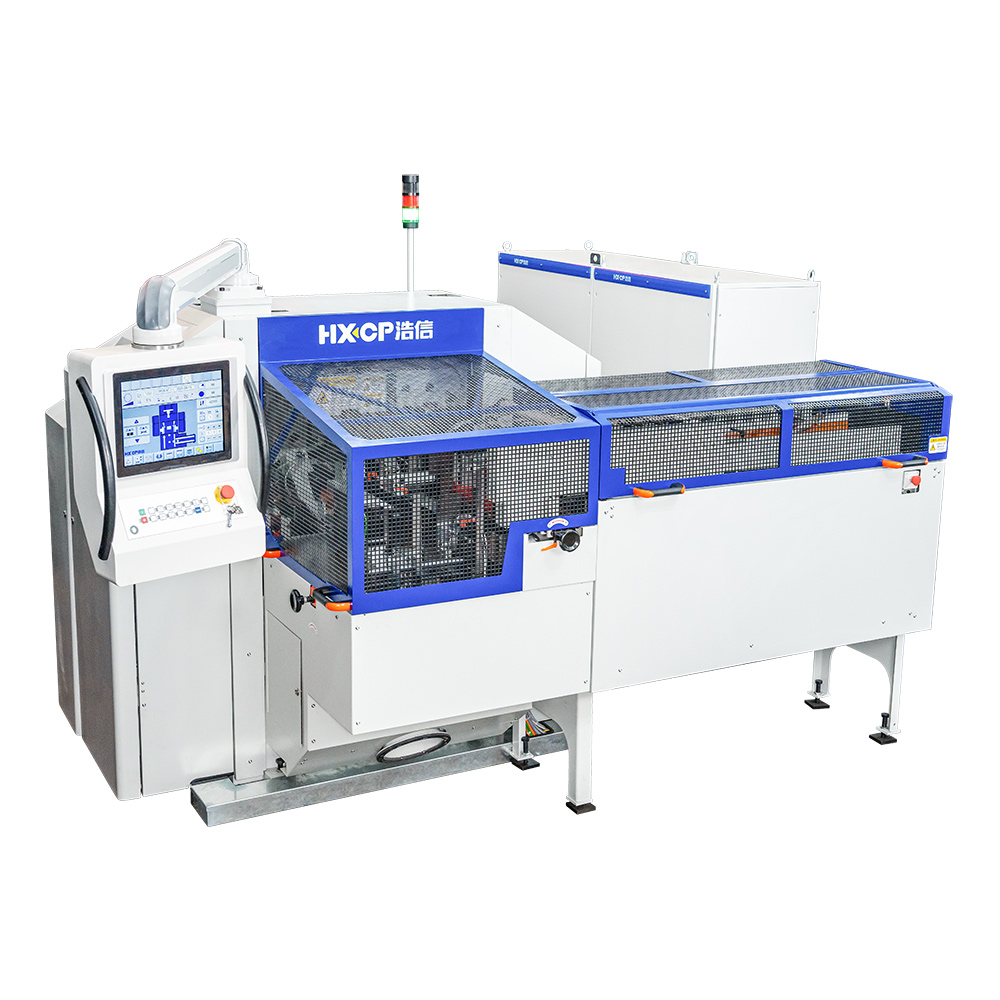 HX120DH High Speed Three Knife Trimmer