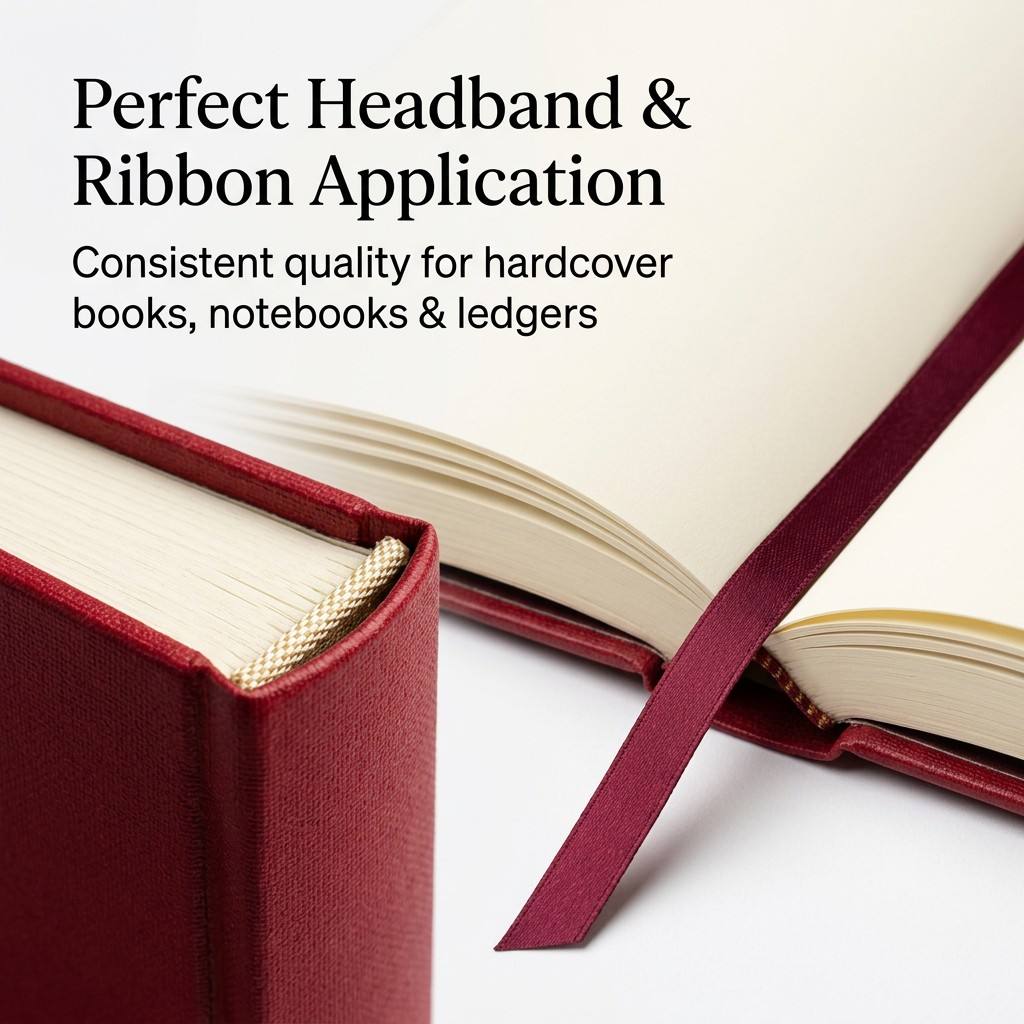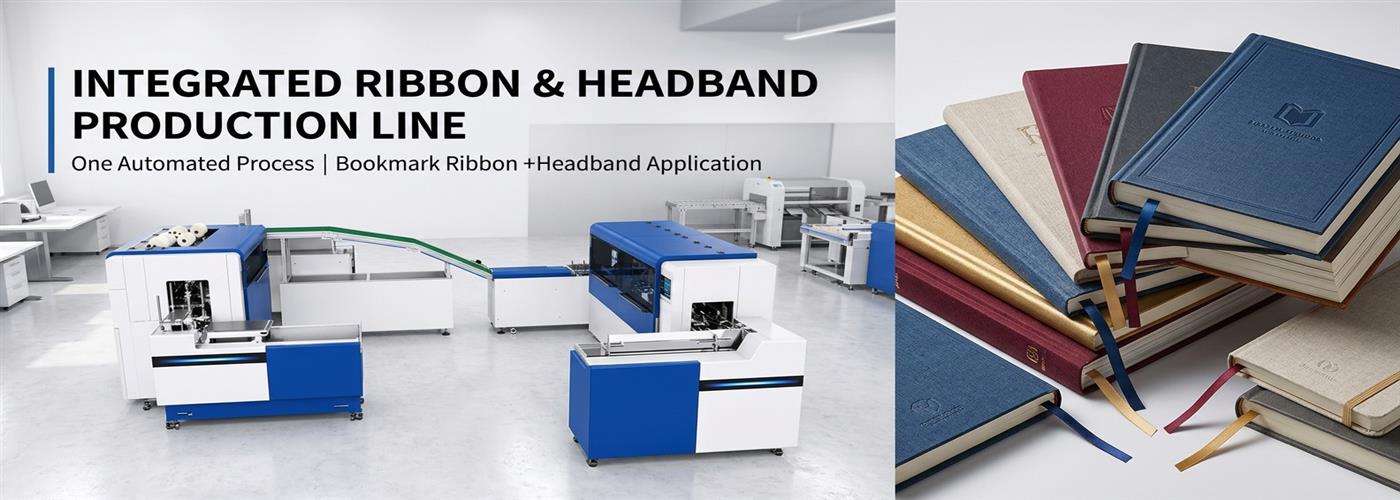
The HX300 Integrated Automatic Ribbon and Headband Application Production Line combines bookmark ribbon attaching and headband application in a single automated process. It performs automatic book feeding, ribbon attaching and tail folding, headband application, book delivery, and stacking.
|
In hardcover book production, two small components cause a disproportionately large share of labor cost: the bookmark ribbon and the headband. Both are attached by hand in most facilities—a worker glues the ribbon to the spine, folds the tail, waits for it to set, then another worker glues the headband across the top and bottom of the spine. At 20 to 40 books per minute of binder output, manual stations simply cannot keep pace. The Automatic Ribbon and Headband Application Line exists to change that arithmetic. Here is what the two approaches actually cost.
What Manual Ribbon and Headband Application Costs in Labor and BottlenecksConsider the manual process in detail. On a typical hardcover line, attaching a bookmark ribbon requires three motions: applying adhesive to the spine area, placing the ribbon at the correct position and angle, and folding the tail neatly inside the book. Then the headband must be cut to length, coated with adhesive, and pressed across the top and bottom of the spine. Done properly, each book takes 10 to 15 seconds of skilled handwork across these two stations. Done at production speed, it takes longer, because the worker must maintain quality while the conveyor keeps moving. At 10 to 15 seconds per book, one worker can process roughly 240 to 360 books per hour. A binder producing 1,200 to 2,400 books per hour needs four to ten workers just for ribbon and headband application. The labor cost compounds: these are skilled positions, because misaligned ribbons and crooked headbands are immediately visible on the finished book. Training takes days, turnover is common, and quality varies from worker to worker and hour to hour. Beyond the visible payroll, manual application creates a bottleneck. If the binder runs faster than the manual stations can consume, books pile up at the ribbon and headband stage. Operators slow the binder to match, sacrificing the entire line's throughput. The ribbon station becomes the constraint that caps production, and the cost of that constraint is measured in every book the line fails to produce.
How the HX300 Line Combines Both Operations into One Automated ProcessThe HX300 Integrated Automatic Ribbon and Headband Application Production Line collapses both manual operations into a single automated pass. Books feed automatically into the machine. The ribbon station applies adhesive, attaches the ribbon at the programmed position, and folds the tail. The headband station cuts, glues, and presses headbands across both spine ends. The finished book delivers and stacks automatically. What required two skilled workers and two separate stations now happens in one continuous flow with zero manual intervention. The productivity difference is dramatic. The line runs at 20 to 40 books per minute—1,200 to 2,400 books per hour—matching high-speed hardcover binding output. One operator supervises the machine, handles format changes, and monitors quality. Where a manual process needed four to ten workers, the automated line needs one. The labor reduction is not incremental; it is an order of magnitude. Calculating the Annual Labor Savings on a Typical Hardcover LineTo quantify the decision, model a facility producing 500,000 hardcover books per year. Under manual application, assuming 300 books per hour per worker and 2,000 production hours per year, the facility needs roughly two to three workers dedicated to ribbon and headband application continuously. With breaks, absences, and quality rework, the practical requirement is three to four workers. At a fully loaded cost of 30,000 to 30,000 to 40,000 per worker per year, manual application costs 90,000 to 90,000 to160,000 annually.
The automated line replaces this entire crew with one supervising operator. The supervisor's cost is one position— 30,000 to 30,000 to 40,000—and the same person can oversee other line operations. The net annual saving is 60,000 to 60,000 to 120,000. At a purchase price typical for an integrated ribbon and headband line, the payback period is 18 to 30 months. After that, the savings continue for the machine's service life, which professional hardcover equipment typically measures in decades. The savings ignore the harder-to-quantify gains: consistent ribbon placement, uniform headband adhesion, reduced rework, and no more production stoppages when a manual station falls behind. These quality gains protect the facility's reputation with publishers who inspect ribbons and headbands closely on premium products. Process Consistency: Why Automation Beats Skilled Hands on Tiny ComponentsRibbons and headbands are small components with zero tolerance for error on premium books. A ribbon placed 2 millimeters off-center is visible to the customer and grounds for rejection by quality-conscious publishers. A headband glued at a slight angle looks crooked on the shelf. Manual application delivers whatever the worker's hands produce at that moment—consistent when the worker is experienced and attentive, inconsistent when fatigued, rushed, or interrupted. The HX300 line removes the human variable entirely. The ribbon station positions each ribbon at the programmed coordinate with mechanical repeatability. Every book receives identical placement, identical tail folding, identical adhesive application. The headband station cuts to precise length and presses each band with the same force and alignment. The result is process consistency measured in fractions of a millimeter, sustained from the first book of the shift to the last—the kind of uniformity that earns a facility preferred-supplier status with premium publishers. The One Touch Format Changeover Advantage for Mixed ProductionHardcover facilities rarely run one format all day. A typical week mixes thick ledgers, medium notebooks, and thin gift books. Every format change on a manual line means retraining hands and re-establishing quality through trial and error—minutes of lost production and several scrapped setup books per changeover. The HX300 line handles format changes through its user-friendly control system. The operator selects the new format profile, and the machine adjusts ribbon position, headband width, and book size settings automatically. The one-touch changeover covers book sizes from 85 by 100mm up to 240 by 300mm and thicknesses from 4 to 60mm. Where a manual changeover costs 15 to 30 minutes of setup and scrap, the automated changeover costs seconds of control input. For facilities running many small lots—the growing norm in premium stationery—this changeover speed is a competitive weapon. It makes short runs economically viable and lets the facility accept mixed orders without penalty. Matching the Line's Speed and Size Range to Your Production MixBefore committing, verify the line's envelope against your products. The HX300 handles book thicknesses from 4 to 60mm, covering the full hardcover spectrum from thin gift books to thick ledgers. Book sizes from 85 by 100mm to 240 by 300mm span most commercial hardcover formats. Ribbon widths from 3 to 13mm accommodate both narrow marker ribbons and wide decorative ribbons. Headband widths from 15 to 17mm match the standard headband sizes used in premium binding. Production speed of 20 to 40 books per minute should be compared against your binder's real output. The line must keep pace with the binder at its sustained speed, not its rated maximum. If your binder delivers 1,500 books per hour and the line runs 20 to 40 per minute—1,200 to 2,400 per hour—the match is adequate with margin. If your binder exceeds 2,400 books per hour, discuss integration with the supplier, since the line also connects into complete hardcover production systems. Infrastructure Requirements Before InstallationThe HX300 is a substantial integrated line. It draws 16kW on three-phase 380V, requiring a dedicated industrial electrical connection. The compressed air requirement of 13 Bar is higher than typical binding equipment—verify your compressor delivers this pressure at the machine inlet, not just at the compressor head, accounting for line losses across the facility. The 3,000kg machine weight demands a level industrial floor with adequate load capacity. Installation planning should include access for the machine's full footprint, clearance for the delivery and stacking station, and space for the control cabinet and operator work area. Most installations complete within one to two weeks including commissioning and operator training on the control system and changeover procedure. The Labor and Quality Case for Automation Is Unusually One SidedRibbon and headband application is one of the few hardcover processes where the manual alternative is almost indefensible on economics. The work is repetitive, skilled, error-prone, and slow. The automated line performs it faster, more consistently, and without fatigue. The labor savings alone typically recover the investment within two to three years, and the quality improvements protect the facility's standing with premium customers. The only scenarios where manual application remains rational are very low volumes—a few thousand books per year where the machine would sit idle—or extremely unusual ribbon placements that cannot be programmed. For any facility running tens of thousands of hardcover books annually, the question is not whether to automate, but how soon the payback calculation starts. |
| Tag:Integrated Ribbon and Headband Machine,Automatic Headband Application Machine,Bookbinding Ribbon and Headband Line |
Please Leave Your Messenger Here!
We will do our best to make your business prosperous!






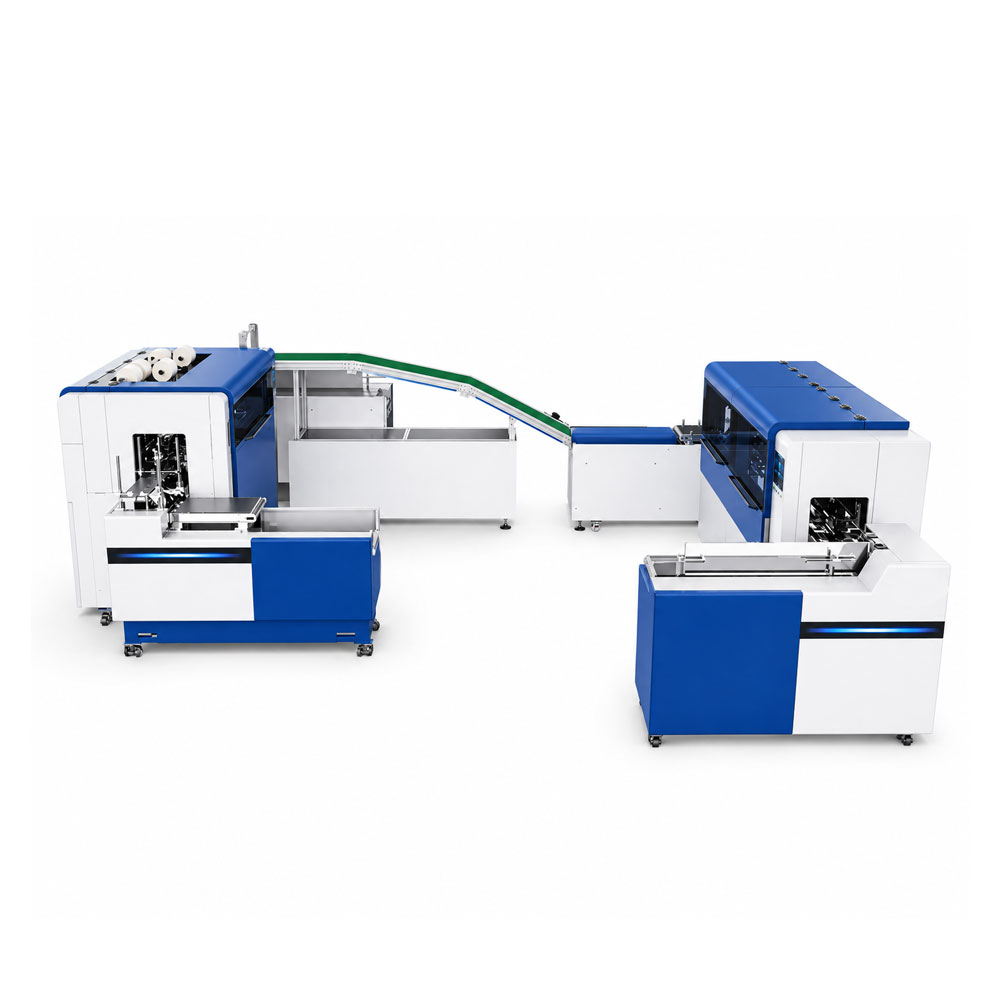 HX300 Integrated Automatic Ribbon and Headband Application Production Line