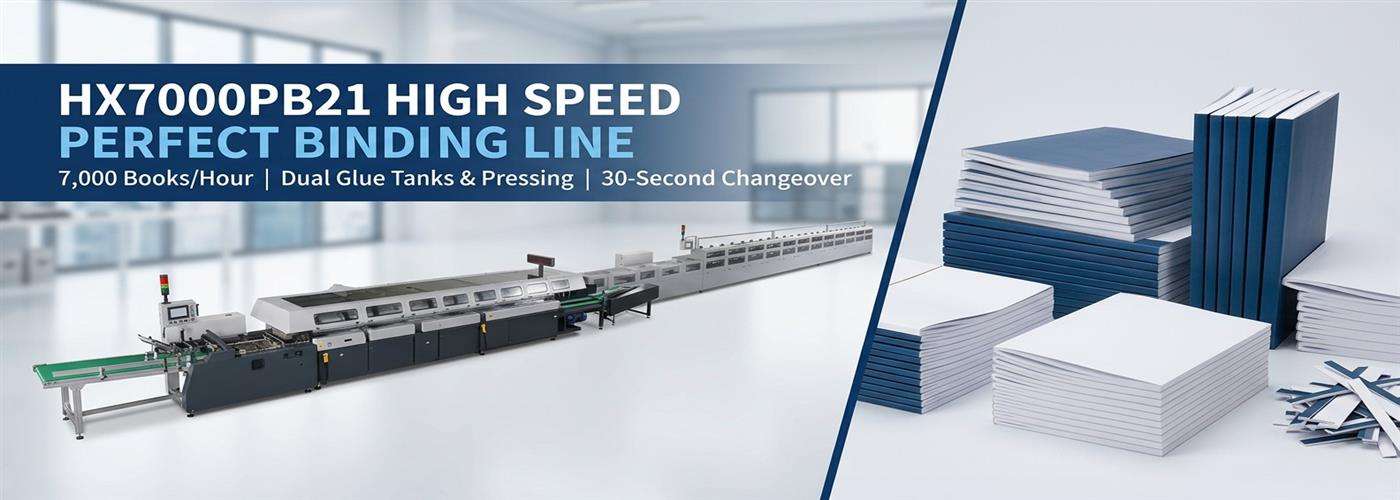
HX7000PB21 High Speed Perfect Binding Production Line is a high-speed system designed for test paper and book binding. It integrates gathering, dual-channel conveying, and perfect binding into a continuous workflow.
|
Test paper production is unlike any other segment of the binding industry. It is deadline-driven, seasonal, and unforgiving of delays. When an education authority issues a tender for a standardized test, the schedule is fixed: the papers must be printed, bound, and delivered by the exam date, with no flexibility and no tolerance for missed deadlines. The batch sizes are enormous—hundreds of thousands of copies of a single title—and the formats change frequently between different test levels and subjects. A Perfect Binding Line built for this market must combine raw speed, rapid changeover, and absolute reliability. The HX7000PB21 was engineered with exactly these requirements in mind.
What Test Paper Binding Demands That Other Binding Does NotTest paper binding occupies a specific niche between commercial bookbinding and high-volume printing. The products include standardized exam papers, mock tests, answer booklets, and study workbooks. They share a set of demanding characteristics: tight deadlines tied to exam calendars, huge batch sizes per title, frequent format changes between subjects and grade levels, and zero tolerance for quality failures—a defective test paper delivered to thousands of students is not a warranty claim, it is a crisis. The format range adds another dimension. Test papers span thin answer booklets of just a few pages up to thick study guides of hundreds of pages. The HX7000PB21's book block thickness range of 3 to 60 millimeters covers this entire spectrum on one machine. The gathering size range of 148 by 105 millimeters to 364 by 257 millimeters spans the standard paper formats used in educational testing. One line, one setup, the full test paper portfolio. Why 7000 Books Per Hour Matters When the Exam Date Is FixedThe exam calendar does not negotiate. When a contract specifies delivery by a fixed date, the bindery's production rate determines whether the deadline is met. The math is straightforward: a contract for 500,000 test papers at a line speed of 7,000 books per hour requires roughly 71 hours of binding time. At a slower line producing 3,000 books per hour, the same contract requires 167 hours—more than twice the machine time, more shifts, more labor, and a thinner margin for error against the deadline. The 7,000 books per hour figure on the HX7000PB21 translates to 21 clamps carrying books continuously through the binding cycle, with the gathering unit feeding the binder through a dual-channel conveyor. The continuous workflow means there is no staging pause between gathering and binding; papers flow from the gathering unit into the binder's clamps without interruption. For a bindery competing on exam-season contracts, this throughput is not a convenience—it is the difference between winning and losing the tender.
The 30 Second Changeover and the Exam Season Format ParadeExam season is a format parade. One day the line runs a 200-page study guide for high school physics; the next day it runs an 8-page answer booklet for a primary school test; the day after, a 96-page mock exam for university entrance preparation. Each format differs in thickness, size, and page count, and the bindery that changes over fastest wins the most contracts. The HX7000PB21's 30-second job changeover converts what is traditionally the most painful part of test paper production into a non-event. The servo-driven control adjusts the binding parameters—clamp pressure, glue application, cover positioning—automatically when the operator selects the new job profile. The line does not sit idle for an hour while a crew reconfigures it; it pauses briefly, changes over in 30 seconds, and resumes at full speed. Across a season with dozens of format changes, the cumulative changeover time saved is measured in days. Dual Channel Conveying and the Continuous Flow AdvantageThe integration between gathering and binding determines whether the line runs smoothly or stutters. The HX7000PB21 uses a dual-channel conveyor to carry gathered signatures from the gathering unit to the binding unit, and the patented sheet flipping and gripper feeding mechanism ensures each signature arrives at the clamp in the correct orientation and position. This synchronization is what sustains 7,000 books per hour without misfeeds or jams. For test paper production, where every minute counts against a fixed deadline, the continuity of flow is critical. A line that stops to clear a misfeed loses production time that cannot be recovered. The continuous, synchronized workflow of the HX7000PB21 minimizes these interruptions, keeping the line running at speed through the long shifts that exam-season deadlines demand. Handling the Thickness Range from Thin Booklets to Thick Study GuidesThe 3 to 60 millimeter thickness range is one of the line's most valuable specifications for test paper production. Thin answer booklets—the 3 to 10 millimeter end of the range—require careful handling: the clamps must grip them firmly without distortion, and the glue must be applied in controlled amounts to avoid bleed-through. Thick study guides—the 40 to 60 millimeter end—require sufficient glue volume, adequate drying time, and strong pressing to achieve a durable bond.
The HX7000PB21 addresses this range with dual spine glue tanks and dual pressing stations. The dual glue tanks maintain consistent adhesive temperature and application across varying thicknesses, and the dual pressing stations provide the dwell time needed for both thin and thick blocks to bond properly. The result is reliable binding quality across the full range of test paper products, from a 6-page answer sheet to a 500-page study manual. Reliability Under Deadline Pressure and the Role of Remote DiagnosticsWhen the exam date is fixed and the line is running three shifts, reliability is everything. A breakdown that stops the line for a day is a day of production that cannot be recovered—and a contract deadline that may be missed. The HX7000PB21's design addresses reliability from two directions. The first is preventive: automatic lubrication keeps the mechanical systems running without the lubrication lapses that cause premature wear, and the servo-driven control reduces the mechanical stress that wears components prematurely. The second is responsive: remote diagnostics and IoT monitoring let the supplier's engineers monitor the line's condition remotely and diagnose problems before they become failures. For a bindery running exam-season deadlines, a line that can be diagnosed and supported remotely—without waiting for an engineer to travel to the site—is a line that can be kept running. The Energy Efficiency Angle in High Volume ProductionTest paper production runs at high volume for concentrated periods, which makes energy efficiency financially significant. The HX7000PB21's servo-driven control delivers energy efficiency through precise power application: each servo drive uses power proportional to the work being done, rather than running continuously at full power like older hydraulic or mechanical systems. Over the long exam-season shifts, the energy savings accumulate into a meaningful reduction in the cost per book. For a bindery competing on tender pricing, every reduction in unit cost strengthens the bid. The combination of high speed, rapid changeover, and energy efficiency gives the HX7000PB21 a cost structure that supports competitive pricing while maintaining margins—the combination that wins exam-season contracts and keeps them profitable.
Verifying the Line Against Your Test Paper PortfolioBefore committing to a line of this scale—the gathering unit alone weighs 7 tons and the binder 6.5 tons—verify the specifications against the facility's actual test paper portfolio. Confirm that every product's gathering size, binding size, and thickness fall within the line's envelope. Confirm the line's speed matches the volume requirements of the contracts the facility pursues. Verify the format changeover time with the supplier's demonstration and references from facilities running similar test paper workloads. The HX7000PB21 is engineered for the specific economics of test paper production: fixed deadlines, huge batches, frequent format changes, and zero tolerance for failure. A bindery that serves this market needs a line that delivers speed, changeover agility, and reliability in one package. The line that meets the exam calendar is the line that wins the tenders. |
| Tag:perfect binding,perfect binder,book binding |
Please Leave Your Messenger Here!
We will do our best to make your business prosperous!





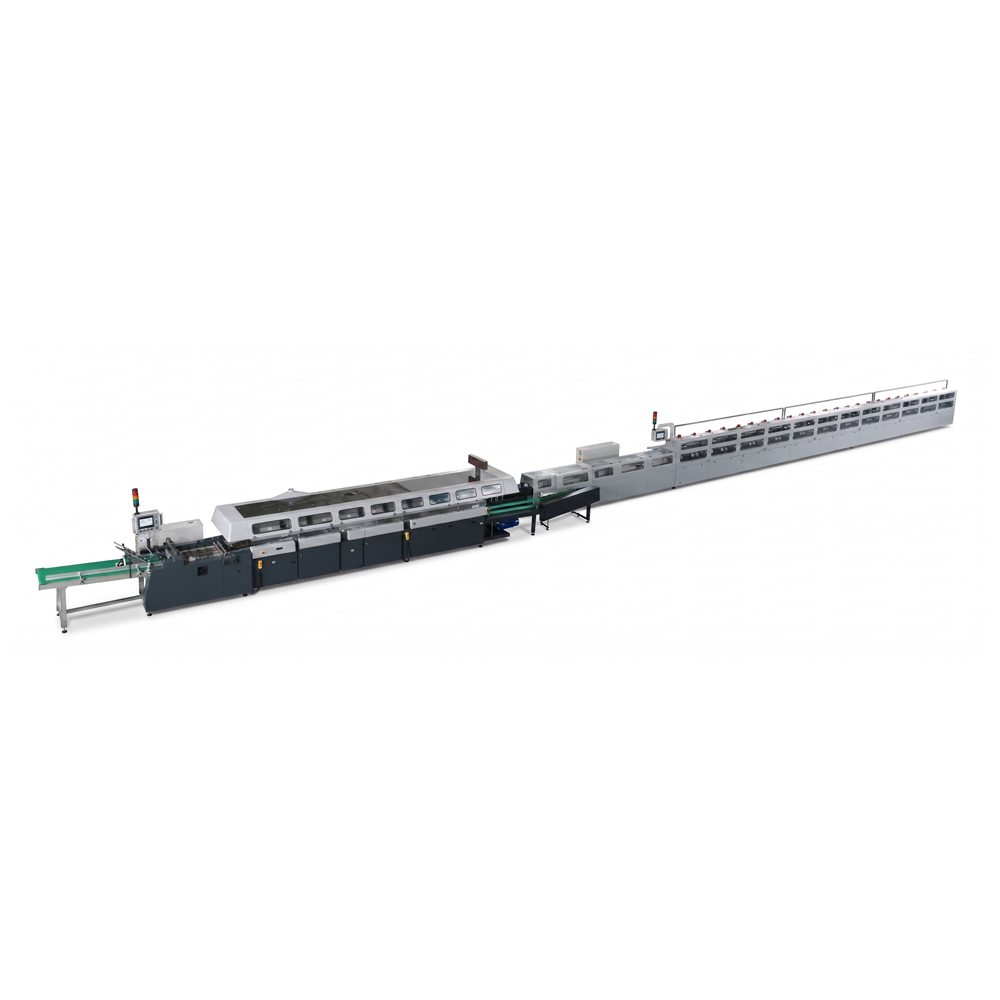 HX7000PB21 High Speed Perfect Binding Production Line